
Mark 13 · Olivet Discourse
Views on the Olivet Discourse in Mark 13
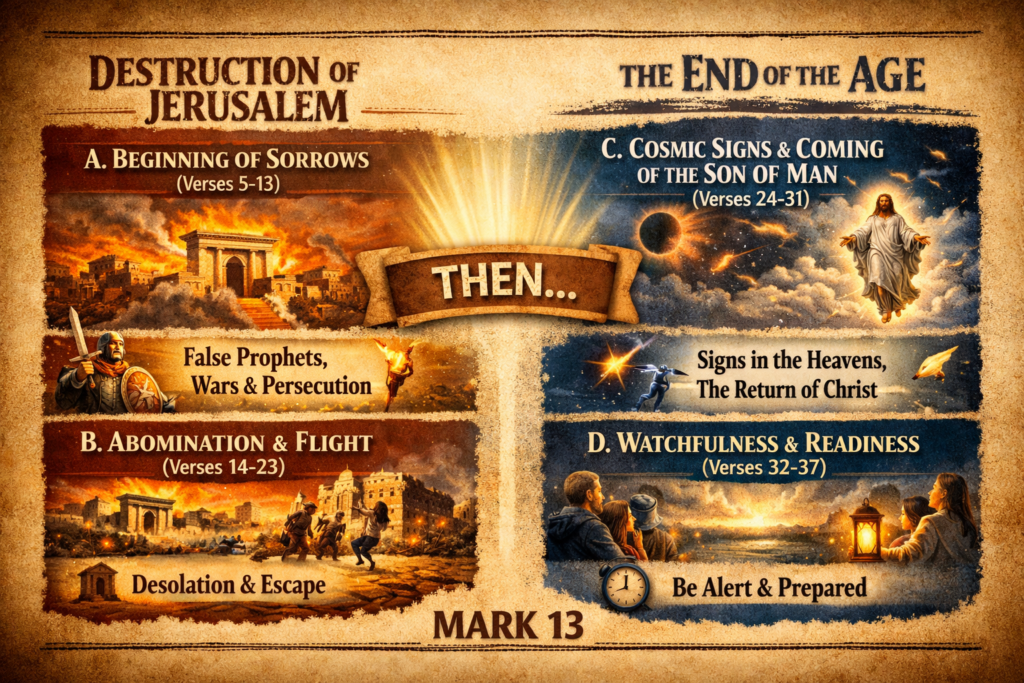
Why this level of detail?
If you’ve spent any time trying to understand Mark 13 — Jesus’s Olivet Discourse — you’ve probably noticed that the same passage gets read very differently depending on who’s writing the commentary. Some teachers act as though the entire chapter is a roadmap to tomorrow’s headlines. Others treat it as ancient history, fully wrapped up when Rome destroyed the temple in AD 70. Still others land somewhere in between. The frustrating part is that these aren’t fringe disagreements — they represent major, well-developed traditions within serious Christian scholarship, and the differences matter for how you read not just Mark 13 but the whole shape of biblical prophecy.
This survey was built to give you something most prophecy discussions don’t: a clear map of who believes what, why they believe it, and where you can go to check it yourself. Rather than presenting one view as obvious and dismissing the others, the table below organizes the major dispensational positions — and the scholars closest to them — into honest categories, with verified citations so you can go straight to the source. Every author is placed in the category that accurately reflects their actual published position, not just a convenient label. Where a scholar’s work provides essential hermeneutical background rather than a direct reading of Mark 13, that’s noted too. The goal isn’t to tell you what to think. It’s to give you a reliable starting point for thinking it through yourself — which is what a Wannabe Bible Scholar deserves.
What this survey is — and what it isn’t
Think of this table as a well-used map, not a construction blueprint. A good map shows you the major roads, landmarks, and territories so you can orient yourself and plan a route. It doesn’t build the road for you, and it doesn’t tell you which destination is worth visiting. That’s your job.
This survey maps the major dispensational interpretive traditions as they apply to the near/far question in Mark 13 — specifically, how each tradition answers the question of whether Jesus’s Olivet Discourse was fulfilled in AD 70, awaits future fulfillment, or involves some combination of both. It is not a comprehensive evaluation of every dispensational argument and counterargument. It does not adjudicate which view is exegetically strongest. It does not cover every scholar who has written on Mark 13, nor does it represent the full range of positions within each tradition — because each of these categories contains its own internal debates, minority voices, and developing scholarship that a single table cannot capture.
What it does do is give you enough verified, correctly categorized information to know where each major tradition stands, who its key voices are, and where to go when you’re ready to dig deeper. Use it to find your bearings. Use it to identify which conversation you want to enter. Use it to ask better questions of the texts and teachers you already trust. But don’t use it as a substitute for the primary resources which include an open Bible, and humble submission to receive insight from the Holy Spirit — because that’s where the real work, and the real reward, of Bible study lives.
Survey Table — Dispensational Views on the Near / Far Question in Mark 13
| Category, view & description | Authors, primary works & full citations |
|---|---|
| Dispensational — Classical · Entire discourse is future; AD 70 has no interpretive role | |
|
Classical dispensationalism
The entire Olivet Discourse addresses the future Jewish tribulation and Second Coming. AD 70 has no fulfillment role whatsoever. “This generation” means the generation alive during the tribulation, not the first century.
|
|
| Dispensational — Revised · vv. 1–2 predict AD 70 literally; remainder of discourse is entirely future | |
|
Revised dispensationalism
Verses 1–2 predict the literal AD 70 temple destruction, but the discourse from verse 3 onward pivots entirely to future tribulational events with no first-century fulfillment.
|
|
| Dispensational — Double Fulfillment (Near/Far) · AD 70 is a typological near fulfillment; future tribulation is the ultimate antitype | |
|
Double fulfillment (near/far)
AD 70 is a genuine, literal near fulfillment that typifies a greater far fulfillment in the future tribulation. The “abomination” was prefigured by Titus in AD 70 and will be ultimately fulfilled by the Antichrist. Near and far are structurally parallel, not mutually exclusive.
|
|
| Progressive Dispensationalism — Already/Not-Yet · Near fulfillment in AD 70 is real and substantial; cosmic vv. 24–27 await eschatological climax | |
|
Progressive dispensationalism
Uses an “already/not yet” hermeneutic. Near fulfillment in AD 70 is real because the kingdom was genuinely inaugurated in Christ. Cosmic language in vv. 24–27 marks the eschatological climax still future. Israel retains a distinctive role, but the church participates in covenant fulfillment in ways classic dispensationalism denied.
|
|
| Conservative Evangelical — Non-Dispensational Near/Far · Structurally parallel to dispensational double-fulfillment but outside dispensational categories; included for comparative scholarly breadth | |
|
Conservative evangelical near/far (non-dispensational)
Distinct from dispensationalism in hermeneutics and ecclesiology; included here because the near/far structural reading overlaps with dispensational double-fulfillment and is frequently cited alongside it in the literature.
These scholars hold that Matt 24 / Mark 13 has a genuine near referent in AD 70 and a genuine far referent in the eschatological end, but they do not maintain a sharp Israel/church distinction or a pretribulational rapture. Their near/far structural reading is similar in shape to dispensational double-fulfillment but arises from different hermeneutical commitments.
|
|
| Mainstream Evangelical — Non-Dispensational Socio-Historical · Included for methodological contrast, not as a dispensational representative | |
|
Mainstream evangelical scholarship (non-dispensational)
These scholars read the Olivet Discourse with attention to both AD 70 and future eschatological horizons but within frameworks that carry no dispensational commitments — no pretribulational rapture, no sharp Israel/church distinction. Valuable for demonstrating that the near/far question is not exclusive to dispensationalism and for showing how mainstream scholarship treats the same passage. Their inclusion clarifies what is distinctive about the dispensational readings listed above.
|
|
| Popular Prophetic Dispensationalism — Generational Clock · AD 70 and modern Israeli history (1948 / 1967) clock the “generation” of v. 30; bulk of discourse applied to imminent tribulation | |
|
Popular prophetic dispensationalism
The fig tree parable is read as a direct reference to the rebirth of national Israel in 1948. AD 70 and modern Israeli history together start the generational clock of verse 30. Strong emphasis on correlating signs to contemporary geopolitical events.
|
|
| Hermeneutical Framework Resources — Not Position-Specific · These works establish the typological and near/far interpretive principles drawn upon across multiple categories above | |
|
Foundational hermeneutics for near/far readings
Works that establish the interpretive groundwork rather than arguing a specific position on Mark 13; cited to help readers understand the exegetical method behind the near/far categories above. These resources explain the typological and prophetic double-fulfillment principles that underlie both dispensational and non-dispensational near/far readings. Useful for readers who want to understand how the method works before engaging the specific positions.
|
|
Wannabe Bible Scholar · Survey Series: Dispensational Views on Mark 13. All citations verified. ISBNs and publisher details current as of 2025.